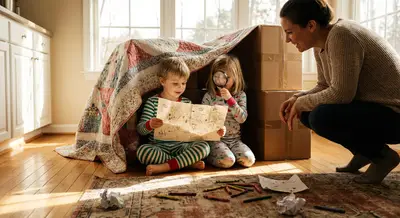
Raising Curious Kids: Turning Everyday Moments Into Learning Adventures
Some days it feels like you’re barely keeping up with the snack requests, let alone planning “educational activities.” The good news: your child doesn’t need a perfect schedule or fancy curriculum to learn. They are already wired to explore, ask questions, and soak up the world around them—and you’re teaching more than you realize, just by living life together.
This guide is about using ordinary moments—breakfast, bath time, errands, bedtime—as quiet powerhouses for your child’s learning. No color‑coordinated bins required, just you, your kid, and a little intention.
Learning Starts With Connection, Not Worksheets
Before we talk about letters, numbers, and skills, it helps to remember: kids learn best when they feel safe, seen, and connected. That means your relationship is the “curriculum” everything else sits on.
Think about how your child lights up when you really listen to their story about the bug they saw, or when you get down on the floor to build a wobbly tower together. Those are moments when their brain is wide open for learning—because they feel secure. Research shows that warm, responsive caregiving supports brain development, attention, and emotional regulation, all of which shape how well kids learn later.
So if today was mostly “We survived” and not “We did three educational activities from Pinterest,” it still mattered. The cuddles while watching a show, the giggles in the bath, the apology after you snapped—those experiences teach your child about trust, communication, and problem‑solving. Academic skills grow much more easily in that kind of soil.
Turning Daily Routines Into Sneaky Learning Moments
You don’t need extra hours in the day to support your child’s education; you can layer learning into what you’re already doing. Here’s what that looks like in real life:
Breakfast Table Talk
You’re pouring cereal, someone is complaining about the wrong color bowl, you’re thinking about coffee. Learning can still fit in.
Language and thinking:
“Do you want the big spoon or the little spoon?”
“What do you think will happen if you pour too much milk?”
“Tell me one thing you’re excited about today.”Math:
“You have 3 strawberries—how many will you have if you eat one?”
“Which cup is more full?”
Real-life scenario: Your 5‑year‑old spills juice and starts to cry. Instead of only focusing on the mess, you might say, “Oops, the cup was too full. How can we solve this?” Now it’s a mini lesson in cause and effect, emotional regulation, and problem‑solving all at once.
Errands as Exploration
Grocery store, pharmacy, school pickup—these can feel like chaos with kids, but they’re great for learning:
- Reading and print awareness: Have your child help “read” logos or signs: “Where do you see the word ‘milk’?” “Can you find the letter M?”
- Math and sorting: Ask them to count apples into a bag, compare sizes of boxes, or sort items by color or type.
- Social skills: Talk out loud about waiting your turn, using polite words with the cashier, and saying “excuse me” when aisles are crowded.
If your child melts down in the cookie aisle (because of course they do), you can still turn it into a teaching moment afterward: “It was hard to hear ‘no’ to cookies. Next time, what could we do when we feel that mad?” Learning isn’t just for calm, Instagrammable moments.
Bedtime as a Built‑In Story Lab
Bedtime can be exhausting—but it’s also a golden time for language and imagination.
- Read together when you can, but even on nights you can’t, try a quick “verbal story”: “Let’s make up a story about a dragon who doesn’t like fire. You say one sentence, then I’ll say the next.”
- Ask simple “why” and “what if” questions about the day’s events. “Why do you think the moon looks different tonight?” Your child’s answer doesn’t have to be scientifically accurate—this is about thinking, guessing, and expressing ideas.
- If your child is anxious or wired at night, storytelling can help them process their day and build emotional vocabulary: “If your feelings were colors today, what colors would they be?”
Even 5–10 minutes of this kind of connection can quietly boost vocabulary, memory, and curiosity.
Supporting Learning at Different Ages Without Overwhelm
Every age comes with its own flavor of chaos and wonder. You don’t need to master them all—just notice what your child is ready for and build from there.
Early Years (1–3): Play Is the Teacher
At this age, almost everything they do is learning:
- Stacking blocks? Physics and spatial awareness.
- Pouring water into (and out of) cups? Early science and fine motor skills.
- Naming body parts during diaper changes or bath? Language and body awareness.
You can support learning by:
- Narrating life: “You’re putting the blue block on top of the red one! Now it’s taller.”
- Letting them try: Even if it’s messier and slower, letting them scoop, pour, and carry things builds confidence and coordination.
- Repeating, not rushing: Kids this age repeat the same play over and over (and over). That’s practice, not a problem.
If your child isn’t into “educational toys,” that’s okay. Pots, pans, boxes, spoons, and couch cushions can be just as stimulating.
Preschool & Early School (3–7): Questions, Questions, Questions
These are the “Why is the sky blue?” years. It can be exhausting, but those questions are gold for learning.
You might:
- Turn questions back to them: “Hmm, what do you think?” before giving an answer. You’re building critical thinking, not just trivia.
- Use play to practice school‑ish skills without pressure: writing their name in shaving cream, “selling” pretend items and using play money, making letters out of playdough.
- Normalize not knowing: “That’s a great question. I don’t know—let’s look it up together.” You’re modeling how to learn, not just what to know.
If they struggle with letters, numbers, or early reading, try to keep the atmosphere light and encouraging. Kids learn at different paces; pushing hard when they’re frustrated can make them dislike learning itself.
Older Kids (8+): Growing Independence (and Opinions)
As kids get older, they often want more control over how they spend their time.
You can:
- Invite them to teach you something (a game, a fact they learned, a Roblox trick). Teaching builds deeper understanding and confidence.
- Involve them in real‑world tasks: measuring ingredients, comparing prices, reading maps, planning routes. This shows them where school skills show up in life.
- Help them break big assignments into smaller steps if they’re in school: “First, let’s list what needs to get done. Then we’ll pick one thing to start with.”
If homework battles are a regular thing, it doesn’t mean you’re failing. It often means your child is tired, overwhelmed, or worried about making mistakes. Short breaks, snacks, and sitting nearby while they work can help more than lectures.
When You Worry Your Child Is “Behind”
It’s common to compare your child to other kids, especially in the age of social media milestones. If you’ve ever thought, “Everyone else’s kid is reading already…what am I doing wrong?” you’re not alone.
A few grounding reminders:
- Kids grow on different timelines. There is a wide range of “normal” for talking, reading, writing, and social skills.
- Struggle doesn’t equal failure. Many kids who need a bit more time or support in one area have strengths in others—creativity, problem‑solving, empathy, spatial skills.
- Your calm matters more than your panic. If you’re worried, it’s okay to talk to your pediatrician or teacher. Getting information and support is an act of care, not a sign you’ve messed up.
If a professional recommends evaluations or services (speech therapy, occupational therapy, extra reading support), it doesn’t mean you did anything wrong as a parent. It means your child is getting a team—more grown‑ups in their corner.
You are not “behind” for asking questions. You are showing up. That’s exactly what your child needs.
Simple Ways to Nurture a Love of Learning (Without Burning Out)
You don’t have to do everything. Pick one or two ideas that feel doable right now:
- Follow their interests. If they’re into dinosaurs, cars, or unicorns, lean in. Books, videos, pretend play, simple crafts—kids learn best when they’re genuinely curious.
- Say what you notice, not just “good job.” Instead of “You’re so smart,” try, “You kept trying different ways until the tower stayed up.” This builds a growth mindset: the idea that effort and strategies matter.
- Let boredom happen sometimes. It’s okay if they’re not constantly entertained. Boredom can be the doorway to creativity, problem‑solving, and self‑directed play.
- Model learning as an adult. Say out loud when you don’t know something and look it up. Let them see you reading, fixing something, or trying a new recipe.
- Protect rest. Brains learn better when kids are rested. It’s okay to say no to activities, extra homework, or one more lesson if your family is stretched too thin.
Above all, remember: you don’t have to turn every moment into a lesson. Your presence, your curiosity, and your willingness to try again tomorrow are more than enough.
Conclusion
You are already your child’s most important teacher—not because you know all the answers or have perfect patience, but because you show up, over and over again, in the middle of real life.
Learning doesn’t only happen at desks or during carefully planned activities. It flows through spilled milk, big questions at bedtime, grocery store meltdowns, car‑ride conversations, and quiet moments on the couch. When you notice those everyday chances to talk, wonder, count, listen, and problem‑solve together, you’re building something deep: a child who believes that learning is part of life, not just something that happens at school.
If today was messy and imperfect, you are in good company. Your love and effort are not invisible, and they matter more than any chart, schedule, or worksheet ever will.
Sources
- Centers for Disease Control and Prevention – Early Brain Development and Health - Overview of how early experiences and relationships shape brain development
- Harvard University Center on the Developing Child – Serve and Return Interaction Shapes Brain Architecture - Explains how back-and-forth interactions with caregivers support learning
- Zero to Three – The Power of Play - Describes why play in the early years is essential for learning and development
- Reading Rockets – Reading Aloud: A Key to Literacy - Details how reading and storytelling with children support language and literacy skills
- American Academy of Pediatrics – How Parents Can Support Early Learning - Practical tips for weaving learning into everyday routines